
Plan Tomorrow Tonight
Friday, October 16, 2026

Most people think a productive day starts when the alarm goes off. Turns out it starts the night before.
Not with a bigger coffee. Not with a better morning routine. With ten minutes, a pen and a page.
I learned this the slow way. For years I woke up each morning and decided what the day would be as I went. Emails first. Messages next. Whatever shouted loudest got my best hours. By the evening I was tired, behind, and unable to point to a single thing that had moved my Big Goal forward.
I was busy. I was not in control. Those are very different things.
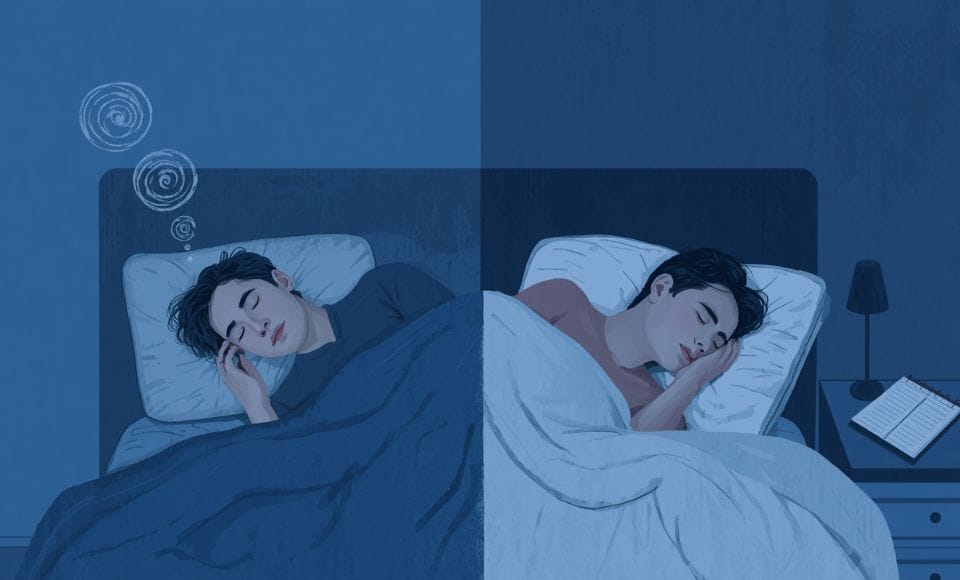
Have you ever lain in bed with your thoughts racing? Ten things to do at work tomorrow. A point you forgot to add to your presentation. A message you meant to send.
Here is what is going on. Your brain is afraid of forgetting. So it keeps replaying the list, over and over, as a kind of safety loop. The more important the task, the louder the replay.
That costs you sleep. And poor sleep costs you focus, patience and willpower for the whole of the next day. The racing thoughts at 11pm are quietly stealing from your 11am.
The fix is simple. Write it down. When you put tomorrow on paper, you signal to your brain that the list is safe. Nothing will be forgotten. It can stand down. That is why I plan my day the night before, in a planner, as the last real thing I do before winding down.
Planning ahead also puts you in the driver's seat. You stop reacting to the day and start choosing its direction. That is the shift this whole series has been building towards.
I tend to see two camps.
The Reactors start the day with no plan. They are capable, willing and hardworking. But their schedule is written by other people's emails, other people's urgencies and whatever lands in front of them first. They end the day exhausted, with plenty done and little that mattered.
The Planners decide the shape of tomorrow tonight. They are not rigid. Their day still goes sideways, because every day does. The difference is they know what matters most, and they have already protected a place for it.
Same hours. Same energy. Very different results.
Here is the exact method I use. It has four parts, and it takes about ten minutes.
At the top of the page, write: "Today, I'm grateful for..." or "Today, I'm grateful that I get to..." and finish it three times.
This is not decoration. Your Reticular Activating System (RAS) is the part of your brain that filters what you notice. Feed it gratitude first, and it starts scanning for good things instead of problems. It weakens the brain's natural negative bias.
It also shifts your inner chi from neutral to positive. You feel more grounded before the day has even asked anything of you.

A needle-mover is a task that, if it were the only thing you finished today, would still leave you feeling good. It moves you closer to your Big Goal.
To find them, use the 80/20 Rule, also known as the Pareto Principle. A small number of tasks, usually one to three, create around 80 percent of your results. They take about 20 percent of the effort.
Write down just those one to three. Not fifteen.
I will be honest. I have never once completed a to-do list of fifteen things. It used to stress me out. Then I realised the goal was never to do everything. It is to do the right things. Being busy and being strategic are not the same.
Your brain has limited processing power and limited energy each day. It was not built to run flat out from dawn to midnight. So the real question is how to put your best brainpower into the few things that actually matter.
These are the things that happen no matter what. School drop-off and pick-up. Working hours if you are employed. Meetings. Exercise. Breakfast, lunch and dinner. Time alone. If you run a business, your business-as-usual tasks belong here too.
Write them all down. They are the fixed posts your day is built around.
Now map the whole day in time blocks. Start by deciding when you will wake up. Work backwards from sleep. If you go to bed at 11pm and need seven hours to function well, then you wake at 6am.
Here is what a day looks like for me when I picture myself as an employee with a young family:
- 6am to 8am: morning routine, one action-based goal, breakfast.
- 8am to 9am: school run and travel to work.
- 9am to 5pm: work.
- 5pm to 6pm: pick up the kids and travel home.
- 6pm to 7pm: a buffer, in case anything overran.
- 7pm to 8:30pm: dinner with the family.
- 8:30pm to 10pm: time with the kids and my wife.
- 10pm to 11pm: plan tomorrow and unwind.
Yes, it sounds like a lot to chart. But a plan like this means you are always facing your Big Goal. You decide the blocks. You decide the tasks. Nothing is left to whoever shouts loudest.
Notice where the action-based goal sits. First thing in the morning, before anyone else is up. That is when my focus is at its peak. By the evening my mental energy is low. If the rest of the day goes haywire, and it will, at least that one step toward my Big Goal is already done.
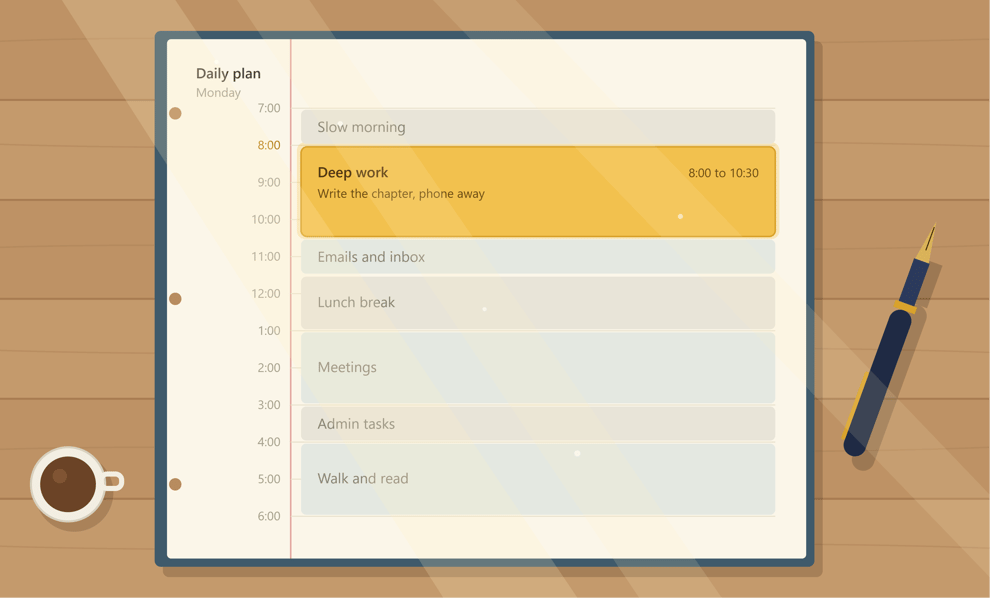
Here is something I have to admit. For a long time I only completed 30 to 50 percent of what I planned.
My coach told me why. It was my ego. I wanted to be the over-achiever, so I crammed in as many tasks as I could. Then I felt lousy when I missed them.
Over-planning does exactly that. It sets you up to feel like a failure by 3pm, and a deflated person does not do their best work.
So be realistic. If your plan is finished and you have spare time, add more. That is a bonus. But if the day collapses, your minimum is simple: finish your needle-mover. Everything else is extra.
This pairs neatly with what we covered on small wins. A finished needle-mover is a win worth noticing. It builds momentum for tomorrow's plan.
* * *

Planning your day is how you take the wheel. It does not say whether the road ahead is leading somewhere worth going.
This lesson covers the inner work: the planning habits, the mental clarity, the calm that lets your brain stop replaying tomorrow all night. It is a vital piece, and it is only one piece.
Your physical environment holds an energy of its own. Set up well, your home and workspace create the conditions for luck and opportunity to flow towards you. But when your inner state is misaligned, with stuck beliefs, contracted emotions and negative self-talk, those opportunities arrive and pass right by, unnoticed or quietly sabotaged. Lasting change needs both sides aligned.
That is the idea behind the Inner and Outer Feng Shui System. It combines over 5,000 years of ancient Chinese energetic wisdom with modern, science-backed psychology, developed by a second-generation Feng Shui master from Singapore and a certified psychotherapist and counsellor. Most programmes work on one side. This one works on both. Because one without the other only gets you halfway.
And you can start learning Feng Shui for free. Click the button below, create your free Skool account, and start watching. A selection of lessons across both Inner and Outer Feng Shui is already unlocked, with no payment and no card required.
Free to start. No card required.
* * *

A racing mind at night is chi that has nowhere to settle. A scattered day is chi spread so thin it reaches nothing.
Daily planning gathers it. Gratitude lifts your inner state. Needle-movers aim your energy at the few things that count. Time blocks give that energy a channel to flow along. Instead of leaking into noise, your chi moves in one direction.
This is the quiet power of an ordinary planner. It is not about squeezing more in. It is about pointing your life force at what matters.
Tonight, before you wind down, give yourself ten minutes. Take a page and do this:
- Write three things you are grateful for tomorrow.
- Pick your one to three needle-movers.
- List your non-negotiables.
- Block out the day, with a buffer built in and your needle-mover placed early.
Then close the planner and let your brain stand down. Tomorrow is handled.
You do not need a perfect morning routine to take control of your life. You need a plan made the night before, one that is realistic, built around what matters most, and protects your best energy for it.
Plan tonight. Sleep better. Wake up with a direction. And let tomorrow start with you in the driver's seat.
See you inside.
Ben

Our Inner & Outer Feng Shui System™
Get FREE immediate access to the Inner & Outer Feng Shui System. Selected lessons unlocked daily — map your home’s 9 life sectors, activate your main door, and harness your inner chi. Simply create your Skool account and start immediately.
Free · Immediate access
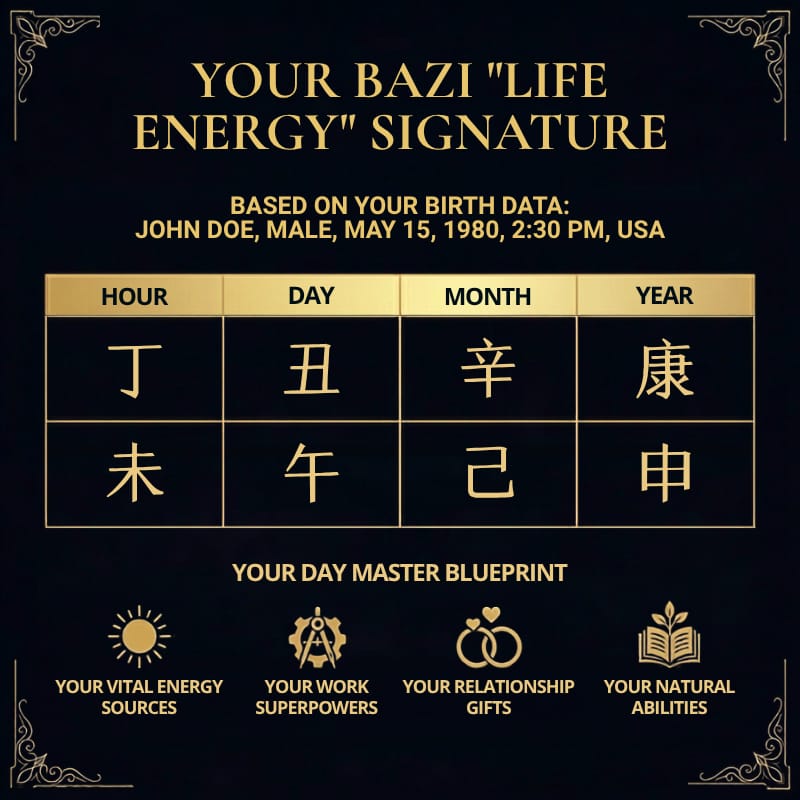
Free BaZi Destiny Life Energy Reading
Discover your Day Master and learn how it is shaping your personality, strengths, and natural luck.
Free · Instant delivery
Follow Us On Our Socials
We Post Daily Content On Internal & External Feng Shui, Spirituality, Manifestation and More!



Privacy Policy | Terms & Conditions
Copyright © 2026 Chi Manifestation. All Rights Reserved.
Your luck is waiting to be aligned
Get a free Day Master BaZi reading, or unlock free access to the Inner & Outer Feng Shui system — no card required, start immediately.
Get Free Resources