
Kua Number: How to Find Your Personal Feng Shui Direction
Thursday, November 26, 2026

Most Feng Shui advice treats everyone the same. The wealth corner is in the same place for every home. The Commanding Position follows the same rules for every person. The front door guidance applies universally, regardless of who lives there.
But within the Eight Mansions school of Feng Shui, there is a layer of the practice that is specifically personal. It begins with a calculation called the Kua Number.
Your Kua Number is derived from your birth year and gender. It assigns you to one of two groups, East or West, and determines your four auspicious directions and your four inauspicious ones. The directions that support you are specific to you. The directions that challenge you are equally specific. And once you know them, the way you use the spaces in your home changes considerably.
The Eight Mansions system, also known as Ba Zhai, is one of the major branches of Compass School Feng Shui. It divides the population into two energetic groups based on the year of birth, and assigns each person a number from one to nine (excluding five, which defaults to two for females and eight for males). This number is the Kua.
The calculation is straightforward. For males born in the twentieth and twenty-first centuries, take the last two digits of the birth year, add them together, and if the result is two digits, add again until you have a single digit. Then subtract from ten. For females, the same initial step applies, but instead of subtracting from ten, you add five. If the result is ten or higher, reduce to a single digit again. Those born before the year 2000 follow the same logic but use slightly different reduction numbers based on the century.
For example, a male born in 1988 would add 8 and 8 to get 16, reduce to 7, then subtract from 10 to arrive at Kua 3. A female born in 1988 would arrive at 7, then add 5 to get 12, reduce to 3. Same birth year, different Kua numbers. This is intentional. The system recognises that the same external circumstances land differently depending on who is experiencing them.
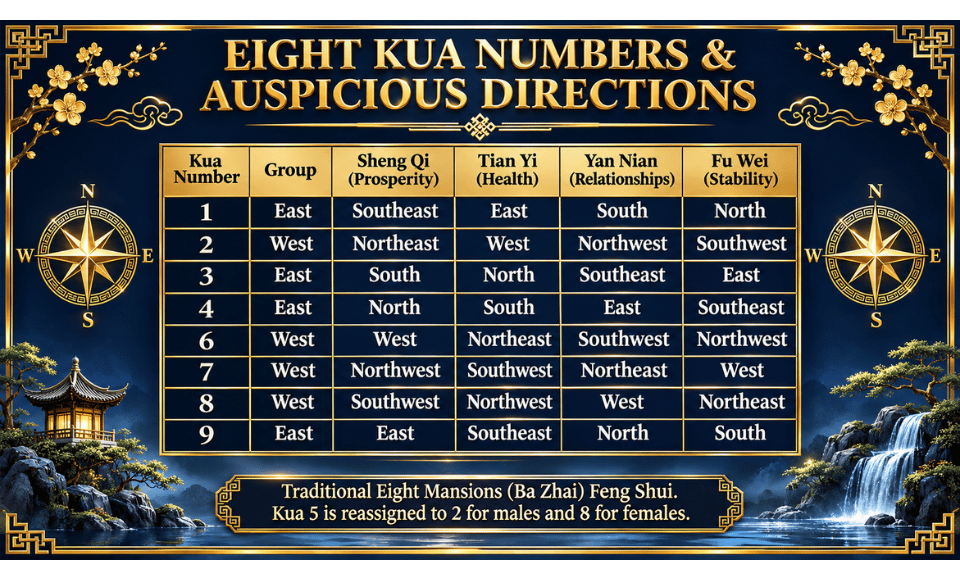
The eight Kua numbers divide into two camps. Kua numbers 1, 3, 4, and 9 belong to the East Group. Kua numbers 2, 6, 7, and 8 belong to the West Group.
Each group has four auspicious directions and four inauspicious directions. East Group people have auspicious directions in the east, north, south, and southeast. West Group people have auspicious directions in the west, northwest, northeast, and southwest. The two groups are mirror images of one another.
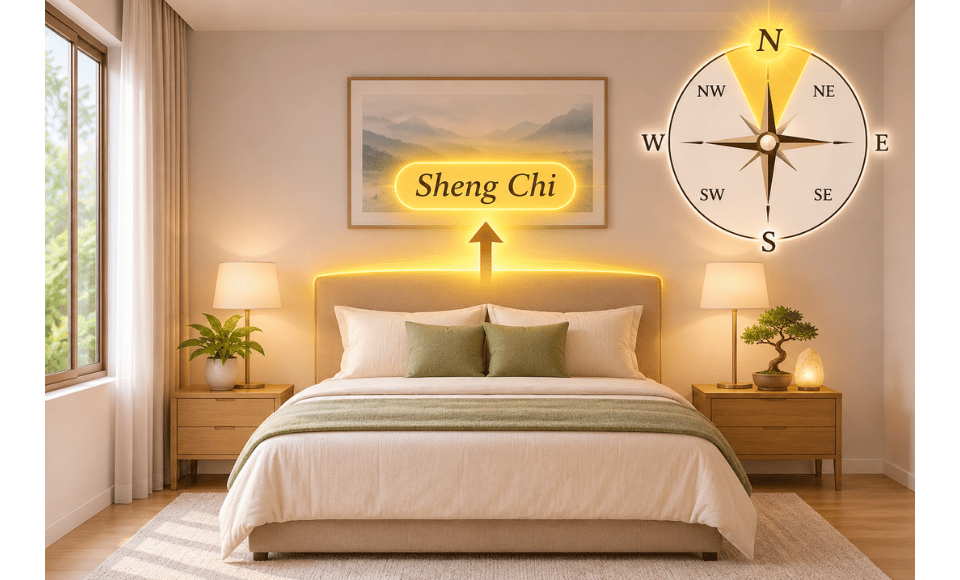
Within the auspicious directions, there is a hierarchy. The most beneficial direction is called Sheng Chi, or vitality. This is the direction that best supports growth, opportunity, and forward momentum. It is used for the most important functions in your life: the direction your desk faces, the direction your head points while sleeping, and the direction you face during important meetings or decisions. The other three auspicious directions, Tian Yi (health), Yan Nian (relationships), and Fu Wei (personal development), each carry their own specific benefit and are assigned to other significant activities.
Among the inauspicious directions, the most significant to avoid is Jue Ming, or life difficulties. This is considered the most challenging direction and is ideally never used for sleep or primary work orientation. The others, Ho Hai (misfortune), Wu Gui (five ghosts), and Liu Sha (six killings), each bring different flavours of challenge: disruption, conflict, and loss respectively.
The most practical application of the Kua Number is in the bedroom. The direction your head points while sleeping, determined by which direction the headboard faces, is the most significant energetic orientation in your life. Aligning the headboard so that your head points toward your Sheng Chi or Tian Yi direction is the first adjustment most practitioners recommend.
Sleeping facing your Sheng Chi direction is said to support ambition, career advancement, and the creation of new opportunities. Sleeping facing Tian Yi, the health direction, is recommended for people who are recovering from illness, managing ongoing health challenges, or who prioritise overall vitality. Yan Nian, the relationships direction, suits those whose primary focus is on building or strengthening partnerships, family bonds, or romantic connections.
The desk comes next. If you can orient your desk so that you face your most auspicious direction while working, you bring the supportive energy of that direction into your most focused productive hours. When this conflicts with the Commanding Position, most practitioners recommend prioritising the Commanding Position first (the ability to see the entrance) and finding a Kua-aligned direction that also satisfies it. These are not always perfectly compatible, but workable compromises are usually available.
The front door and stove are also assessed using Kua Number principles. For the stove, the direction the cook faces while standing at the hob is taken into account. For the front door, there is a distinction between the direction the door faces (its sitting and facing direction) and the direction the occupant faces when stepping out of the home. Both carry energetic significance.

The Kua Number is one of the most personalised tools in classical Feng Shui. It reflects the idea that the same environment can support or challenge different people in different ways, and that knowing your own energetic orientation makes the entire practice more precise. If you would like to explore this further, I would like to invite you inside Chi Manifestation, the Inner & Outer Feng Shui program I built together with Master Dom, a second-generation Feng Shui master in Singapore. It covers both Outer Feng Shui, working with the energy of your physical environment using the same ancient principles that guided Chinese emperors for over 5,000 years, and Inner Feng Shui, the internal work that ensures you can act on what a well-aligned environment creates.
It is free to start. Click the button, create your free Skool account, and begin watching straight away. A selection of lessons is already unlocked, with nothing to pay.
In a shared home, the Kua Numbers of different family members will rarely align perfectly. A husband and wife may belong to different groups, with auspicious directions that point in opposite directions. Children will have their own numbers. The question of whose Kua directions the home should prioritise is one of the most common practical challenges in Eight Mansions practice.
The general guidance is to prioritise the head of the household or the primary earner first, as the person whose energetic orientation most shapes the household's overall fortune. If that person's bedroom orientation is aligned, the benefits tend to extend through the household. For other family members, wherever possible, their own Kua directions are applied to their personal spaces, particularly the bedroom and desk.
When exact alignment is not achievable, the guiding principle is to ensure that the most used positions in the most important rooms are oriented toward an auspicious direction for the primary occupant, and to avoid the most harmful direction, Jue Ming, for anyone in the household.
One of the most important things to understand about the Kua Number is what it is not. It is one input into a larger system, not a complete practice on its own. It tells you which directions support your personal energy. It does not replace Form School assessments, the Commanding Position, or the management of Sha Chi and stagnant energy.
Many practitioners use the Kua Number as a refinement layer: once the basics are in place and the major Feng Shui problems are addressed, the Kua directions help you optimise what is already a sound foundation. Trying to apply Kua directions in a space that has significant structural problems is a less effective use of the tool.
Start with your birth year and calculate your number. Identify your Sheng Chi direction. Check where your head is pointing when you sleep, and where you face when you work. These two adjustments alone, made with awareness and intention, can produce noticeable shifts. From there, you have a foundation for going deeper.

Our Inner & Outer Feng Shui System™
Get FREE immediate access to the Inner & Outer Feng Shui System. Selected lessons unlocked daily — map your home’s 9 life sectors, activate your main door, and harness your inner chi. Simply create your Skool account and start immediately.
Free · Immediate access
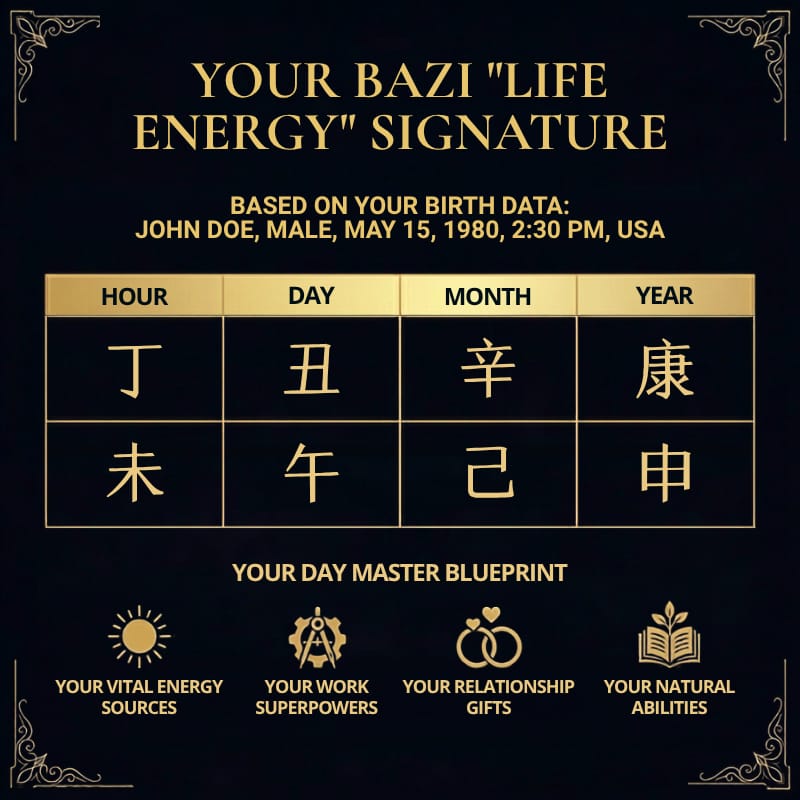
Free BaZi Destiny Life Energy Reading
Discover your Day Master and learn how it is shaping your personality, strengths, and natural luck.
Free · Instant delivery
Follow Us On Our Socials
We Post Daily Content On Internal & External Feng Shui, Spirituality, Manifestation and More!



Privacy Policy | Terms & Conditions
Copyright © 2026 Chi Manifestation. All Rights Reserved.
Your luck is waiting to be aligned
Get a free Day Master BaZi reading, or unlock free access to the Inner & Outer Feng Shui system — no card required, start immediately.
Get Free Resources