
The Three Feng Shui Schools: And Why They Sometimes Disagree
Thursday, November 19, 2026
Most people who stumble into Feng Shui arrive through the same door. They search for something specific: how to arrange their bedroom, what to do about the staircase facing the front door, whether a water feature will help their finances. They find several articles. And then they find something unexpected. The articles disagree.
One source says the wealth corner is the far back-left of the home. Another says the wealth corner depends on your compass direction. A third says none of that matters if the landscape around the building is wrong. These are not minor variations. They are fundamentally different instructions drawn from fundamentally different frameworks.
What most of those articles do not explain is that Feng Shui is not one single school of thought. It is a tradition with thousands of years of history, one that has branched, evolved, and adapted across cultures and centuries. The contradictions you encounter online are real. But understanding where they come from makes the whole field far less confusing, and far more useful.

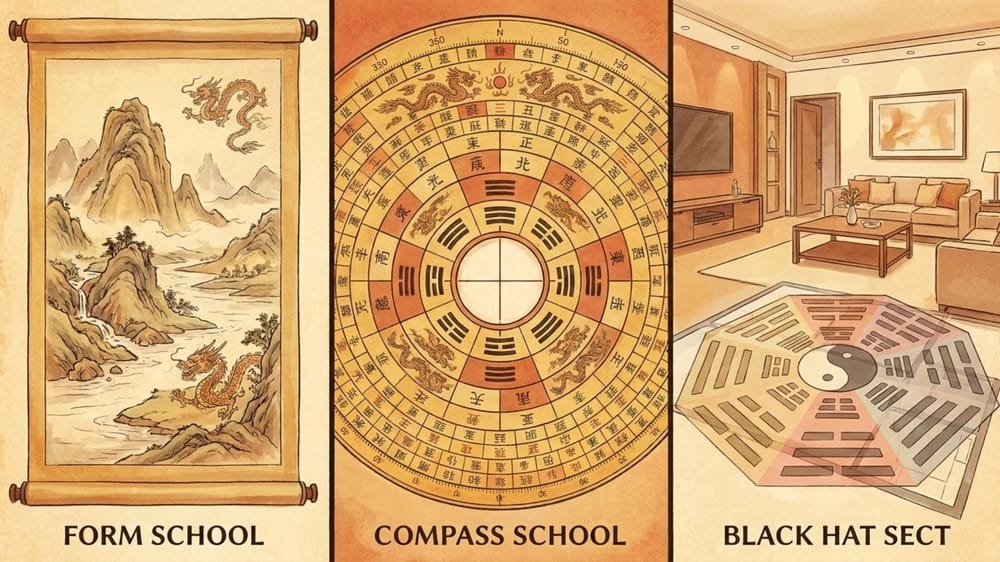
The oldest branch of Feng Shui is the Form School, sometimes called Luan Tou. It developed in ancient China at a time when most people were choosing locations for homes, villages, and burial sites. The question was practical and urgent: which landscapes protect you, and which expose you to harm?
Form School practitioners read the natural world. They looked for mountains behind a site (representing protection and stable energy), hills or rises to the left and right (representing support from both sides), open space in front (representing opportunity and clear vision), and gentle water flowing nearby (representing the gathering and preservation of Chi). These four features correspond to the Four Celestial Animals in Chinese tradition: the turtle behind, the dragon to the left, the tiger to the right, and the phoenix in front.
A site with all four features was considered naturally auspicious. A site missing one or more of them required remedies, or was simply avoided. This logic applied not just to the landscape scale but to the immediate surroundings: buildings, fences, trees, roads, and even the shape of the roof next door could function as beneficial or harmful landforms depending on their relationship to the property.
The Form School is still the foundation of most classical Feng Shui practice today. Its principles are considered largely non-negotiable: even if other adjustments are made using different methods, Form School practitioners hold that you cannot override the influence of the physical landscape. A beautiful interior in a problematic exterior location will always be working against itself.
The Compass School, known in Chinese as Li Qi, introduced a different layer of analysis. Where Form School practitioners read the landscape, Compass School practitioners calculated relationships between direction, number, time, and the energy of a specific building or person.
At its heart, the Compass School is built around the Luo Pan, the traditional Feng Shui compass. The Luo Pan contains many concentric rings, each representing a different aspect of energy: the eight trigrams, the five elements, the 24 mountains (the compass is divided into 24 directions of 15 degrees each), the flying stars, and more. A trained practitioner takes a compass reading at the front door and cross-references it with the building period, the birth data of the occupants, and the internal floor plan to determine the energy distribution of the space.
The most widely practised Compass School method today is Flying Star Feng Shui, also called Xuan Kong. Flying Stars assigns numbers to each of the nine sectors of a floor plan based on a time-and-direction calculation. Some numbers bring auspicious energy in a given period; others bring challenges. The practitioner identifies where the beneficial stars have landed and activates those areas, and identifies where problematic stars are located and applies remedies.
Another important Compass School method is Eight Mansions, or Ba Zhai. This system calculates a personal Kua number from the occupant's birth year, divides the home into eight sectors, and determines which sectors support and which challenge that specific person. It produces four auspicious directions and four inauspicious ones, which guide where the person should sleep, work, and eat.
Compass School methods are powerful because they are specific. They move beyond general principles into precise calculations that account for time, direction, and individual energy. The tradeoff is complexity. Without proper training, it is easy to apply Compass School methods incorrectly, which is a significant reason why contradictory advice circulates online.
In the 1970s, a Tibetan Buddhist teacher named Professor Lin Yun brought a simplified approach to Feng Shui to Western audiences. This system, known as Black Hat Sect Feng Shui or BTB (Tibetan Tantric Buddhist) Feng Shui, fundamentally redesigned how the Bagua map is applied.
In classical Feng Shui, the Bagua is oriented by compass direction. South is always at the top; each of the eight trigrams corresponds to a fixed compass point. Black Hat Sect replaced this with an entrance-based orientation: the Bagua is always aligned with the front door, regardless of compass direction. The area immediately inside the entrance is always the Career sector. The far back-left is always Wealth. The far back-right is always Relationships.
This change made Feng Shui dramatically more accessible. You no longer needed a compass, a birth date, or years of training. You simply stood at the entrance, laid the Bagua over your floor plan, and identified which areas corresponded to which life areas. Within the Western world in particular, this became the dominant form of Feng Shui taught in books, courses, and online resources.
Classical practitioners have mixed views on Black Hat Sect. Some consider its departure from compass orientation a fundamental error that produces inconsistent results. Others acknowledge that the psychological clarity and intention-setting it encourages can produce genuine shifts, even if the mechanism differs from classical theory. The debate continues, and the gap between the two camps remains significant.

Understanding which school is behind the advice you are reading changes everything. If you would like to explore a system grounded in classical principles, I would like to invite you inside Chi Manifestation, the Inner & Outer Feng Shui program I built together with Master Dom, a second-generation Feng Shui master in Singapore. It covers both Outer Feng Shui, working with your home's physical energy using the same ancient principles that guided Chinese emperors for over 5,000 years, and Inner Feng Shui, the internal work that ensures you are ready to receive what a well-aligned home opens up.
It is free to start. Click the button, create your free Skool account, and you can begin watching straight away. A selection of lessons across both Inner and Outer Feng Shui is already unlocked, with no payment required.

Despite their differences, the three major schools share a core set of principles that hold across all traditions.
All three recognise that Chi, the vital energy flowing through a space, can either support or undermine the people living there. All three acknowledge the importance of the Commanding Position: the principle that the main bed, desk, stove, and seating should be positioned so the occupant can see the room's entrance without being directly in line with it. All three take seriously the concept of Sha Chi, the sharp, cutting, or stagnant energy that arises from certain physical configurations. And all three treat decluttering and cleanliness as prerequisites for any other work, because a cluttered space restricts the flow of Chi regardless of which school is applied.
These shared principles are the safest starting point for anyone new to Feng Shui. When you encounter conflicting advice on the more advanced methods, returning to these universals gives you a stable foundation to work from.
If you are practising Feng Shui independently, the most practical approach is to begin with Form School principles and the shared universals. Assess the landscape and exterior of your property first. Clear clutter and repair anything broken. Place your bed, desk, and stove in the Commanding Position. These steps are supported by all three schools and represent the highest-agreement level of Feng Shui practice.
From there, if you want to go deeper, choose one additional system and learn it properly rather than mixing methods. If you are drawn to the analytical precision of Flying Stars or Eight Mansions, work with a classical practitioner or invest time in a structured course. If the entrance-based Bagua of Black Hat Sect feels intuitive and practical, use it consistently. The confusion that most people experience comes not from the schools themselves but from applying fragments of multiple systems simultaneously.
The goal is not to become an expert in all three traditions. It is to develop a coherent, internally consistent practice that you can apply with confidence. When you understand which school a piece of advice comes from, you can decide whether it fits your current framework, and whether to integrate it or set it aside.
Feng Shui has endured for thousands of years because it addresses something real: the relationship between the spaces we inhabit and the quality of life we experience within them. The fact that it has evolved into multiple traditions is not a weakness. It is evidence of a living system that has been tested, refined, and adapted by practitioners working in different environments, different eras, and different cultural contexts.
The contradictions you encounter are real. But they are not reasons for confusion. They are invitations to understand the system more deeply. When you know the source of a piece of advice, you can evaluate it properly. And when you find the approach that resonates, you can follow it with clarity rather than uncertainty.
Our Inner & Outer Feng Shui System™
Get FREE immediate access to the Inner & Outer Feng Shui System. Selected lessons unlocked daily — map your home’s 9 life sectors, activate your main door, and harness your inner chi. Simply create your Skool account and start immediately.
Free · Immediate access
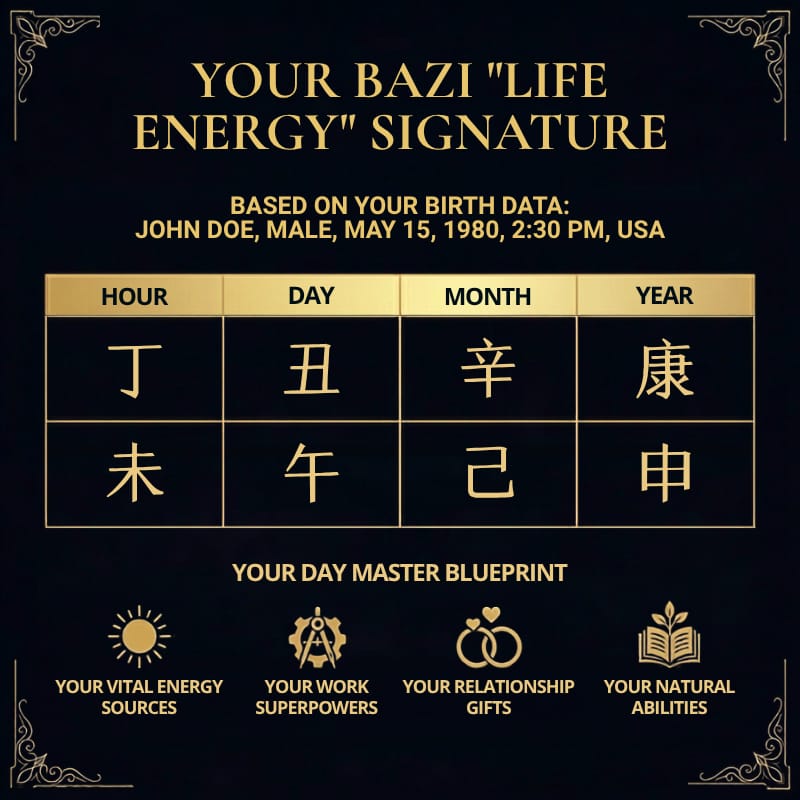
Free BaZi Destiny Life Energy Reading
Discover your Day Master and learn how it is shaping your personality, strengths, and natural luck.
Free · Instant delivery
Follow Us On Our Socials
We Post Daily Content On Internal & External Feng Shui, Spirituality, Manifestation and More!



Privacy Policy | Terms & Conditions
Copyright © 2026 Chi Manifestation. All Rights Reserved.
Your luck is waiting to be aligned
Get a free Day Master BaZi reading, or unlock free access to the Inner & Outer Feng Shui system — no card required, start immediately.
Get Free Resources